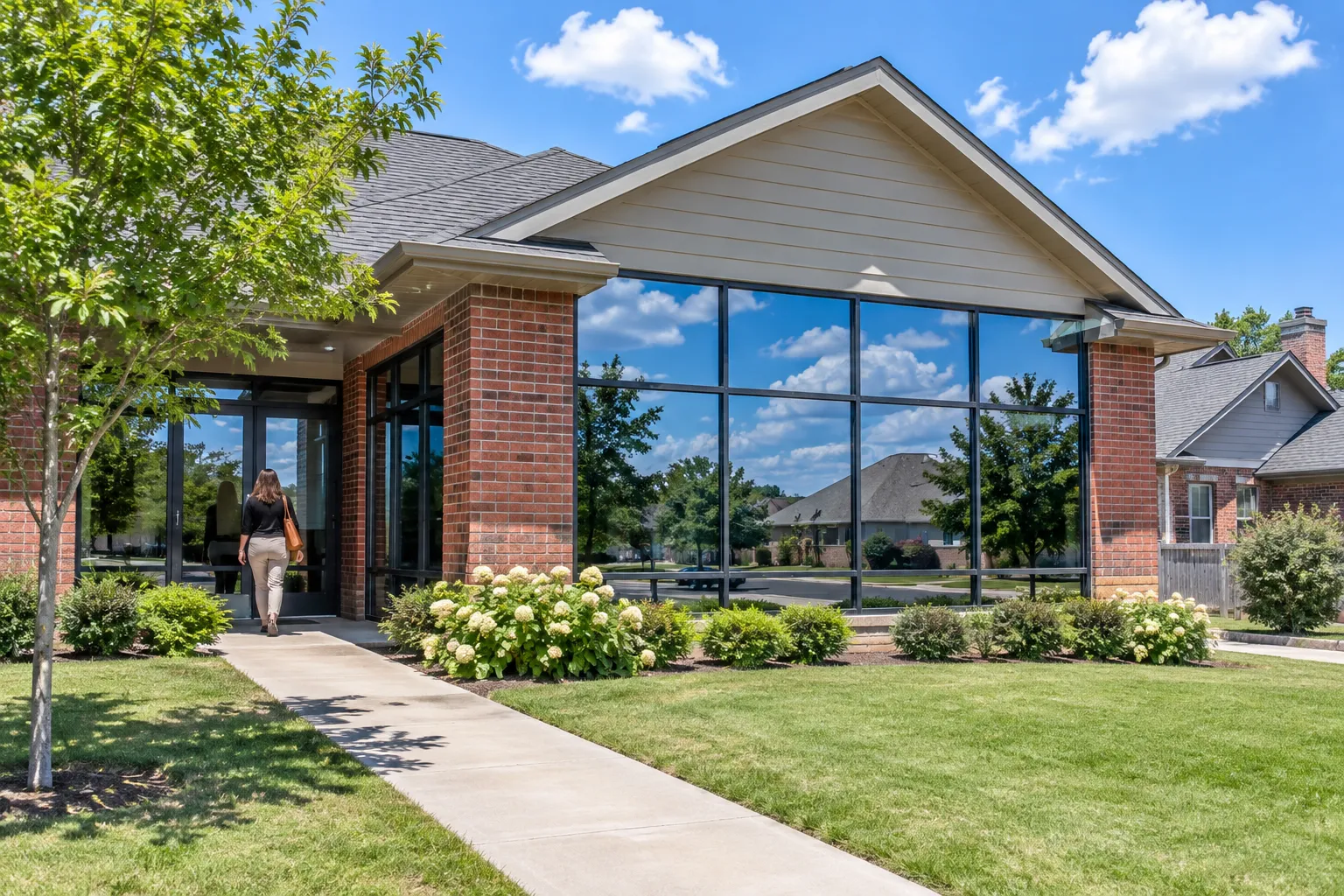
Reflective window film is a film with a thin metallized layer that bounces a large share of the sun's energy back off the glass before it heats the room. It is one of the most effective films for cutting solar heat and glare, and in daylight it looks like a mirror from outside, which also gives privacy. The trade-offs are the mirrored look, a darker view from inside, and privacy that disappears at night. This page explains how it works, where it fits in an Oklahoma City home or office, and how it compares with ceramic film.
How does reflective window film work?
Reflective film carries a microscopically thin layer of metal that reflects visible light and infrared heat away from the glass. Because it turns sunlight back rather than absorbing it, it can reject a high share of total solar energy. The same reflective layer creates the mirror look from the brighter side of the glass.
The International Window Film Association describes heat control films as working by reflecting or absorbing solar energy, with results that depend on film type, installation, window orientation and climate. Reflective films sit at the reflecting end of that range, which is why they are often the strongest option on hard-hit west glass.
When is reflective film the right choice?
Reflective film suits glass that takes intense afternoon sun where a mirrored look is acceptable: west walls, sunrooms, garage apartments, home offices with glare problems, and commercial buildings. It is also a good daytime privacy film for street-facing rooms. It is a poor fit where you want a natural look from the street or a bright view inside.
Good fits:
- A west-facing room nobody looks out of in the afternoon.
- A sunroom that is unusable on summer afternoons.
- A street-facing living room where daytime privacy matters.
- Office glazing on a sunny elevation, if the building's look allows it.
Poor fits:
- Historic or HOA homes where mirrored glass isn't allowed.
- Rooms where a bright, natural view matters most; consider ceramic window film instead.
- Bathrooms needing night privacy; consider privacy window film.
Does reflective film give privacy at night?
No. Reflective film gives privacy only while it is brighter outside than inside. After dark, with lights on inside, the effect reverses: people outside can see in, and you see your own reflection. Plan on blinds or curtains for evenings, or use frosted film where you need privacy around the clock.

This is the most common surprise with mirror film. The physics and the options for real night privacy are on day and night privacy window film and one-way mirror film.
How does reflective film compare with ceramic film?
Reflective film often rejects as much heat as ceramic film or more, and usually costs less, but it looks mirrored from outside and makes the view from inside darker. Ceramic film rejects heat by absorbing infrared, keeps glass light and natural, and costs more. Choose by how much the look and the view matter to you.
| Reflective film | Ceramic film | |
|---|---|---|
| Heat rejection | Often highest | High |
| Look from outside | Mirrored by day | Close to unchanged |
| View from inside | Darker, slight tint | Bright, natural |
| Daytime privacy | Yes | No |
| Guide price, installed | about $6 to $8 per sq ft | about $10 to $20 per sq ft |
Guide prices come from published cost guides checked in November 2026. For the heat question in general, see heat control window film.
Is reflective film safe on double-pane or low-e windows?
It can be, with the right product. Some films raise the glass temperature more than others, and film makers publish film-to-glass tables that say which films suit which glass. The IWFA explains that glass breaks when stressed and that installers use these tables, which you can ask to see, to choose a suitable film.
Details are on tinting double pane windows and window film on low-e glass.
Will my HOA allow reflective window film?
Some HOAs and historic districts restrict mirrored or reflective finishes on glass visible from the street. Rules vary, so read your covenants or ask the HOA before choosing it. Interior glass and windows that can't be seen from the street are less likely to be restricted.
In Oklahoma City's historic districts, such as Heritage Hills, it's worth checking local guidance first; our Heritage Hills page has notes on older original glass.
Does reflective film interfere with phone signals?
It can, in some cases. Heavily metallized films may weaken cell or radio signals passing through the glass, which mostly matters in homes or offices that already have weak reception. Ceramic films, which film makers describe as metal-free, are the usual alternative where signal is a concern.
How much does reflective window film cost?
Published guides list reflective film at about $6 to $8 per square foot installed, which makes it one of the cheaper ways to cut a lot of solar heat. Small jobs usually meet the installer's minimum charge, and access or old film removal add to the price. You get a written quote after a visit before anything starts.
More on costs on cost to block heat through windows and window tinting cost. Tell us which glass is the problem and we'll arrange a visit.
Questions people ask
Does reflective window film really reduce heat?
Yes. Reflective film turns a large share of solar energy back before it heats the room, which makes it one of the most effective heat films, especially on west and south glass. Exactly how much depends on the product and the window, so compare the total solar energy rejected figure on its spec sheet.
Can you see out of reflective window film?
Yes, during the day you see out clearly, though the view is a little darker than through clear glass. At night, with lights on inside, the glass reflects the room back at you and it is harder to see out. Lighter reflective films keep more of the view.
Is reflective film the same as one-way mirror film?
They are closely related. Reflective film is the broad category; one-way mirror film is a reflective film chosen mainly for privacy, usually with a stronger mirror effect. Both work by light levels, so both give privacy by day and not at night with lights on inside.
Does reflective film fade or change color?
Quality reflective films are made to keep their appearance for many years, and metallized layers don't fade the way dyed films can. Cheap films may discolor or delaminate sooner. Check the manufacturer's written warranty for what it covers on appearance and adhesion.
Can reflective film go on the outside of a window?
Exterior reflective films exist and stop heat before it reaches the glass, which helps on some glass types. They face weather, hail and cleaning, so they wear faster than interior film. Most homes use interior film; exterior film is more common on certain commercial glass.
Read on
- Exterior film
When window film goes on the outside of the glass, what low-reflective films are for, how they handle glare and neighbor complaints, and…
See window tinting oklahoma city for the other services and what they cost.
Sources
- International Window Film Association, heat control
- International Window Film Association, FAQ
- Published window film cost guides (Angi, HomeAdvisor), checked November 2026
Last changed