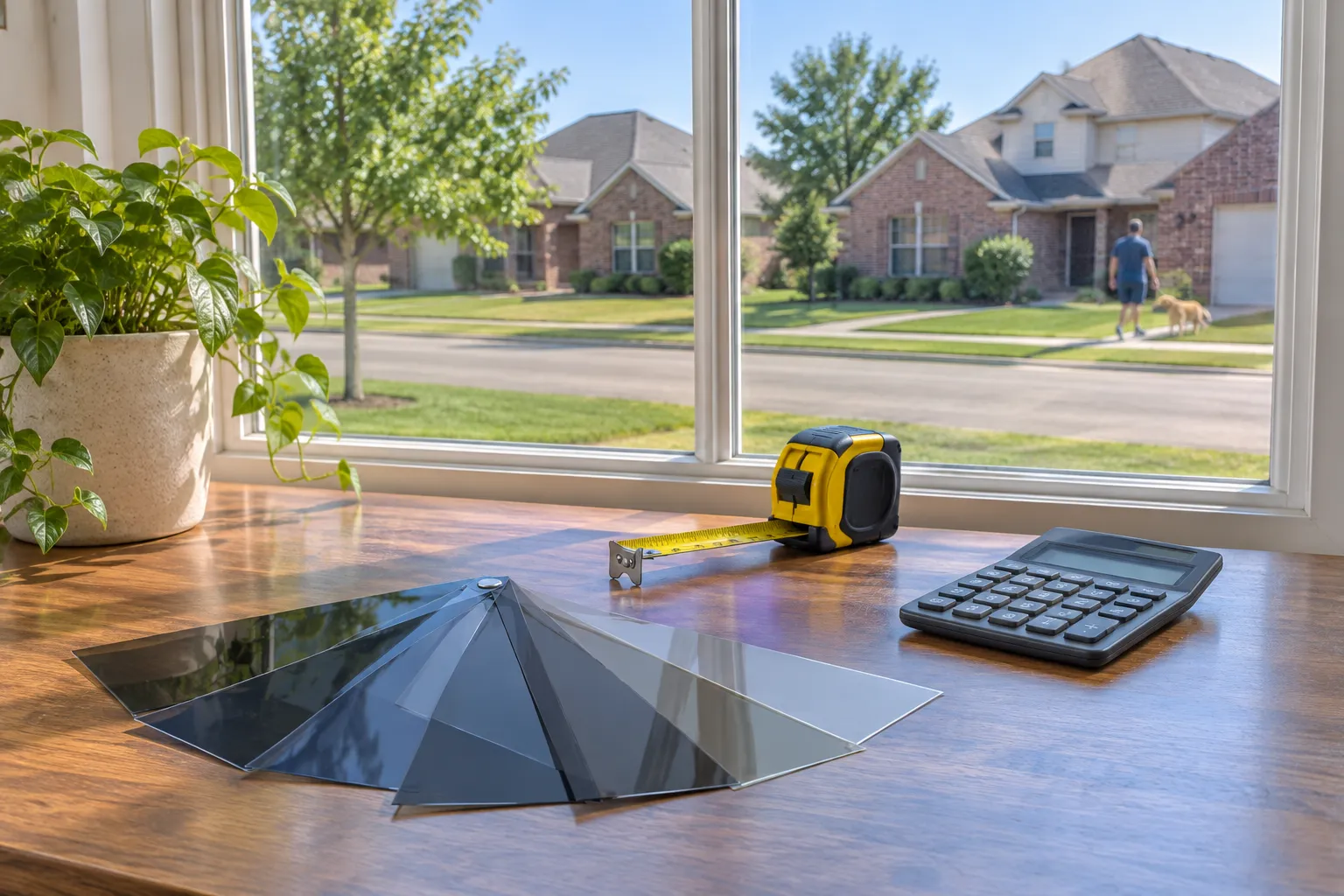
Professionally installed window film costs roughly $5 to $15 per square foot for most home jobs, according to the national cost guides we checked in November 2026, with ceramic film around $10 to $20 and specialty films more. This page is the overview for window tinting in Oklahoma City: a price table by film type, three worked examples, the things that push a quote up or down, and links to the detailed cost page for each film. These are guide prices. The real price for your windows comes in a written quote after a visit.
How much does window tinting cost per square foot?
Most installed window film falls between $5 and $15 per square foot. Basic UV and glare films sit at the bottom of that range, solar and frosted films in the middle, and ceramic and security films toward the top or above it. Switchable smart film is in a different bracket, at $30 or more per square foot.
| Film type | Guide price, installed, per sq ft | Detailed page |
|---|---|---|
| Standard UV and glare film | about $5 to $10 | Home window tinting cost |
| Solar control film | about $8 to $14 | Cost to block heat through windows |
| Reflective film | about $6 to $8 | Reflective window film |
| Ceramic film | about $10 to $20 | Ceramic window film cost |
| Frosted film | about $6 to $10 | Decorative window film cost |
| Decorative patterns | about $6 to $13, custom higher | Decorative window film cost |
| Security and safety film | about $7 to $15, anchored systems more | Security window film cost |
| Switchable smart film | about $30 to $45 | Switchable privacy glass cost |
Ranges come from HomeAdvisor, Angi, HomeGuide, HomeStars, This Old House and Bob Vila, checked November 2026. Guides don't always agree, and some list film-only prices, so treat these as installed ballparks.
How much does it cost to tint a whole house?
A whole house depends far more on how much glass it has than on its size. Tinting only the sunny windows of a typical house often lands in the low thousands of dollars, while every window in a glass-heavy house with ceramic film can cost several times that. Measure the glass you actually want to treat, then multiply by the film's price.
Three worked examples, using mid-range guide prices:
| Job | Glass | Film | Rough guide total |
|---|---|---|---|
| West living room picture window and a sliding door | about 80 sq ft | Standard solar film at about $10 | about $800 |
| All south and west windows of a single-story house | about 200 sq ft | Ceramic film at about $15 | about $3,000 |
| Two bathroom windows and a front door sidelight | about 25 sq ft | Frosted film at about $8 | under $250, so the minimum charge applies |
The last example is the one people don't expect: small jobs often cost the installer's minimum charge, commonly around $250, whatever the square footage.
What makes a window tinting quote go up or down?
The film you choose sets the base price, and the job sets the rest: how much glass, how many separate panes, how easy the windows are to reach, and whether old film has to come off first. Large jobs often cost less per square foot because setup and travel are spread over more glass.
The main factors, roughly in order of impact:
- Film type and grade. Ceramic and security films can cost twice as much as standard film for the same window.
- Total square feet. More glass costs more overall, less per foot.
- Number and shape of panes. French doors and divided-light windows take far longer than one big pane. This Old House lists French doors at about $10 to $19 per square foot.
- Access. Skylights, second-floor glass and tall storefront panels need ladders or lifts. Skylights can reach about $19 per square foot.
- Old film removal. Taking off failed film and adhesive adds labor, often a few dollars per square foot.
- Glass type. Some double-pane or low-e glass needs a specific, sometimes pricier, film to stay within the film maker's guidance.
Is professional installation worth the extra cost over DIY?
For large panes, double-pane or low-e glass, skylights and anything you want to last, usually yes. DIY film from a store costs much less per square foot, but it tends to be thinner, harder to get bubble-free, and comes without the installer's workmanship warranty. For a small bathroom window, DIY can be fine.
Professional jobs also come with a manufacturer-backed written warranty on the film, which the International Window Film Association lists as one of the things to ask for before you buy. Our guide to DIY window tinting vs hiring an installer covers when each makes sense.
How do I compare window tinting quotes?
Compare like with like: the same film product, the same windows and the same scope. Check the film's name and grade, the square footage, whether old film removal and cleanup are included, the warranty terms for both the film and the workmanship, and whether the installer checked your glass type before recommending the film.
Questions worth asking each installer, many of them from the IWFA's buying advice:
- Which exact film, and what are its heat rejection, light and UV figures?
- Is the film approved for my glass type?
- What does the warranty cover, and for how long?
- Is removal of old film included?
- How long does the job take, and how long until I can clean the film?
Does window film pay for itself?
Sometimes, on very sunny glass. Film lowers the solar heat a room gains, which can reduce cooling costs, and it slows fading of floors and furniture. How fast it pays back depends on how much of your cooling load comes through the windows. For many homes, comfort is the main return, with energy savings as a bonus.
We go into the numbers, and why they vary so much between houses, on window film energy savings. For offices and stores, see commercial window tinting cost.
How much does commercial window tinting cost compared with homes?
Commercial film is quoted the same way, per square foot, and guide prices are similar: roughly $5 to $15 for standard office film, with large projects often at the lower end because of bulk pricing. Access, after-hours work and lifts can add to the total. Security and decorative films cost more, as they do at home.
The full commercial breakdown is on commercial window tinting cost.
How do I get an exact price for my windows?
Tell us which windows and what you want the film to do, and we'll arrange a visit from a local installer. They measure the glass, check its type, show you samples and give you a written quote. Nothing starts until you agree to it. That quote, not a guide range, is the price that counts.
Questions people ask
What is the average cost of residential window tinting?
Published guides put installed residential film at roughly $5 to $15 per square foot. A job covering a few sunny windows often costs several hundred to around a thousand dollars, and treating most of a house's sunny glass with ceramic film can run to a few thousand. Small jobs usually hit a minimum charge, often about $250.
Is $100 for two windows a good price for tint?
For house windows, $100 for two would be unusually low for professional film, since most installers have a minimum charge around $250. It is closer to what DIY film costs. A quote that low for professional work is worth checking: which film, what warranty, and whether it is the same type of job.
Why is window tinting priced per square foot?
Because film is sold and cut by area, and most of the labor scales with the amount of glass. Per-square-foot pricing lets you compare quotes fairly. Installers then add for things that take extra time, such as many small panes, hard-to-reach windows or removing old film.
Is ceramic tint much more expensive than regular tint?
Usually about double. Guides put installed ceramic film at around $10 to $20 per square foot, against roughly $5 to $10 for standard film. The extra buys high heat rejection while keeping glass light and the view natural, so it is most worth it on sunny windows you look out of.
Does removing old window film cost extra?
Usually, yes. Taking off failed film and cleaning the adhesive is slow work, so installers charge for it, often a few dollars per square foot on top of the new film. Some include it in one price. Ask for it as a separate line so quotes are comparable.
Sources
- Published national window film cost guides (HomeAdvisor, Angi, HomeGuide, HomeStars, This Old House, Bob Vila), checked November 2026
- International Window Film Association, before you buy
Last changed